According to the Bible, the two tablets of stone constituting the "testimony" or evidence of God's covenant with the people (Deuteronomy 31:26) were kept within the Ark itself. The Tanakh states in I Kings 8:9 that there "was nothing in the ark save the two tables of stone". Some see this as contradictory with other verses, claiming the presence of the "pot of manna" (Ex. 16:34), and "Aaron's rod that budded" (Num. 17:25) before the Ark (Heb. 9:4 - in the Ark). The items were placed "before the Ark with the testimony"; the correct meaning of that phrase is open to interpretation.
Even Aaron, brother of Moses and the High Priest, was forbidden to enter the place of the Ark too often. He was enjoined to enter the Holy of Holies only once per year on a designated day, and to perform certain ceremonies there (Lev. 16). Moses was directed to consecrate the Ark, when completed, with the oil of holy ointment (Ex. 30:23-26); and he was also directed to have the Ark made by Bezaleel, son of Uri of the tribe of Judah, and by Aholiab, the son of Ahisamach of the tribe of Dan (Ex. 31:2-7). These instructions Moses carried out, calling upon "every wisehearted" one among the people to assist in the work (Ex. 35:10-12). Bezaleel the artist made the Ark (Ex. 37:1); and Moses approved the work, put the testimony in the Ark, and installed it.
In Deut. 10:1-5 a different account of the making of the Ark is given. Moses is made to say that he constructed the Ark before going upon Mount Sinai to receive the second set of tablets. The charge of carrying the Ark and the rest of the holy implements was given to the family of Kohath (of the tribe of Levi). They, though, were not to touch any of the holy things that were still uncovered by Aaron (Num. 4:2-15).
Prophets' Mentions The Ark of the Covenant is mentioned by prophets in both the Bible and the Qur'an.
In the Bible
 The Ark carried into the TempleThe only mention of the Ark in the books of the prophets is the reference to it by Jeremiah, who, speaking in the days of Josiah (Jer. 3:16), prophesies a time when the Ark will no longer be needed because of the righteousness of the people. In the Psalms, the Ark is twice referred to. In Ps. 78:61 its capture by the Philistines is spoken of, and the Ark is called "the strength and glory of God"; and in Ps. 132:8, it is spoken of as "the ark of the strength of the Lord."
The Ark is mentioned in one passage in the deuterocanonical 2 Maccabees 2:4-10, which contains a reference to a document saying that the prophet Jeremiah, "being warned of God," took the Ark, and the tabernacle, and the altar of incense, and buried them in a cave on Mount Nebo (Deut 34:1), informing those of his followers who wished to find the place that it should remain unknown "until the time that God should gather His people again together, and receive them unto mercy." Hebrews 9:4 states that the Ark contained "the golden pot that had manna, and Aaron's rod that budded, and the tables of the covenant." Finally, in Revelation 11:19, the Ark is described as being in heaven, just before the woman clothed with the sun appears (Book of Revelation 12).
In the Qur'an
According to some Muslim scholars, the Ark of the Covenant does not have a religious basis in Islam and Islam does not give it any special significance while others believe that it will be found by Mahdi near the end of times. These Islamic scholars believe inside there will be relics left by the people of Moses and the people of Aaron. There might be the sceptres of Moses (eg., Nehushtan), Aaron's rod, Plates of the Torah, and Aaron's turban.
History Mobile vanguard
In the march from Sinai, and at the crossing of the Jordan, the Ark preceded the people, and was the signal for their advance (Num. 10:33; Josh. 3:3, 6). The Ark of the Covenant burned the thorns and other obstructions in the wilderness roads. According to tradition, sparks from between the two cherubim killed serpents and scorpions. (Canticles iii)
During the crossing of the Jordan, the river grew dry as soon as the feet of the priests carrying the Ark touched its waters; and remained so until the priests -- with the Ark -- left the river, after the people had passed over (Josh. 3:15-17; 4:10, 11, 18). As memorials, twelve stones were taken from the Jordan at the place where the priests had stood (Josh. 4:1-9).
The Ark was carried into battle, such as in the Midian war (Num. 31). During the ceremonies preceding the capture of Jericho, the Ark was carried round the city in the daily procession, preceded by the armed men and by seven priests bearing seven trumpets of rams' horns (Josh. 6:6-15). After the defeat at Ai, Joshua lamented before the Ark (Josh. 7:6-9). When Joshua read the Law to the people between Mount Gerizim and Mount Ebal, they stood on each side of the Ark. The Ark was again set up by Joshua at Shiloh; but when the Israelites fought against Benjamin at Gibeah, they had the Ark with them, and consulted it after their defeat.
Captured by the Philistines The Ark is next spoken of as being in the tabernacle at Shiloh during Samuel's apprenticeship (1 Sam. 3:3). After the settlement of the Israelites in Canaan, the ark remained in the tabernacle at Gilgal for a season, then was removed to Shiloh until the time of Eli, between 300 and 400 years (Jeremiah 7:12), when it was carried into the field of battle, so as to secure, as they supposed, victory to the Hebrews; and it was taken by the Philistines (1 Sam. 4:3-11), who sent it back after retaining it seven months (1 Sam. 5:7, 8) because of the events said to have transpired. After their first defeat at Eben-ezer, the Israelites had the Ark brought from Shiloh, and welcomed its coming with great rejoicing.
In the second battle, the Israelites were again defeated, and the Philistines captured the Ark (1 Sam. 4:3-5, 10, 11). The news of its capture was at once taken to Shiloh by a messenger "with his clothes rent, and with earth upon his head." The old priest, Eli, fell dead when he heard it; and his daughter-in-law, bearing a son at the time the news of the capture of the Ark was received, named him Ichabod - explained as "Where is glory?" in reference to the loss of the Ark (1 Sam. 4:12-22).
The Philistines took the Ark to several places in their country, and at each place misfortune resulted to them (1 Sam. 5:1-6). At Ashdod it was placed in the temple of Dagon. The next morning Dagon was found prostrate, bowed down, before it; and on being restored to his place, he was on the following morning again found prostrate and broken. The people of Ashdod were smitten with boils; a plague of mice was sent over the land (1 Sam. 6:5). The affliction of boils was also visited upon the people of Gath and of Ekron, whither the Ark was successively removed (1 Sam. 5:8-12).
After the Ark had been among them seven months, the Philistines, on the advice of their diviners, returned it to the Israelites, accompanying its return with an offering consisting of golden images of the boils and mice wherewith they had been afflicted. The Ark was set in the field of Joshua the Beth-shemite, and the Beth-shemites offered sacrifices and burnt offerings (1 Sam. 6:1-15). Out of curiosity the men of Beth-shemesh gazed at the Ark; and as a punishment over fifty thousand of them were smitten by the Lord (1 Sam. 6:19). The Bethshemites sent to Kirjath-jearim, or Baal-Judah, to have the Ark removed (1 Sam. 6:21); and it was taken to the house of Abinadab, whose son Eleazar was sanctified to keep it. Kirjath-jearim was the abode of the Ark for twenty years. Under Saul, the Ark was with the army before he first met the Philistines, but the king was too impatient to consult it before engaging in battle. In 1 Chronicles 13:3 it is stated that the people were not accustomed to consult the Ark in the days of Saul.
In the Days of King David At the very beginning of his reign, David removed the Ark from Kirjath-jearim amid great rejoicing. On the way to Zion, Uzzah, one of the drivers of the cart whereon the Ark was carried, put out his hand to steady the Ark, and was smitten by the Lord for touching it. David, in fear, carried the Ark aside into the house of Obed-edom the Gittite, instead of carrying it on to Zion, and here it stayed three months (2 Sam. 6:1-11; 1 Chron. 13:1-13).
On hearing that the Lord had blessed Obed-edom because of the presence of the Ark in his house, David had the Ark brought to Zion by the Levites, while he himself, "girded with a linen ephod," "danced before the Lord with all his might"�a performance for which he was despised and scornfully rebuked by Saul's daughter Michal (2 Sam. 6:12-16, 20-22; 1 Chron. 15). This unjustified derision on her part resulted in the permanent loss of her fertility. In Zion, David put the Ark in the tabernacle he had prepared for it, offered sacrifices, distributed food, and blessed the people and his own household (2 Sam. 6:17-20; 1 Chron. 16:1-3; 2 Chron. 1:4).
Levites were appointed to minister before the Ark (1 Chron. 16:4). David's plan of building a temple for the Ark was stopped at the advice of God (2 Sam. 7:1-17; 1 Chron. 17:1-15; 28:2, 3). The Ark was with the army during the siege of Rabbah (2 Sam. 11:11); and when David fled from Jerusalem at the time of Absalom's conspiracy, the Ark was carried along with him until he ordered Zadok the priest to return it to Jerusalem (2 Sam. 15:24-29).
In Solomon's Temple When Abiathar was dismissed from the priesthood by Solomon for having taken part in Adonijah's conspiracy against David, his life was spared because he had formerly borne the Ark (1 Kings 2:26). It was afterwards placed by Solomon in the temple (1 Kings 8:6-9). Solomon worshiped before the Ark after his dream in which the Lord promised him wisdom (1 Kings 3:15). In Solomon's Temple, a Holy of Holies was prepared to receive the Ark (1 Kings 6:19); and when the Temple was dedicated, the Ark -- containing nothing but the two Mosaic tables of stone -- was placed therein. When the priests emerged from the holy place after placing the Ark there, the Temple was filled with a cloud, "for the glory of the Lord had filled the house of the Lord" (1 Kings 8:10-11; 2 Chron. 5:13, 14).
When Solomon married Pharaoh's daughter, he caused her to dwell in a house outside Zion, as Zion was consecrated because of its containing the Ark (2 Chron. 8:11). King Josiah had the Ark put into the Temple (2 Chron. 35:3), whence it appears to have again been removed by one of his successors.
The Babylonians and Afterwards When the Babylonians destroyed Jerusalem and plundered the temple, the Ark entered the domain of legend. Many historians suppose that the ark was probably taken away by Nebuchadnezzar and destroyed. The absence of the ark from the Second Temple was acknowledged.
Fate of the Ark In contrast to the general consensus of historians (that supposes that the ark was taken away and destroyed), variant traditions about the ultimate fate of the Ark include the intentional concealing of the Ark under the Temple Mount, the removal of the Ark from Jerusalem in advance of the Babylonians (this variant usually ends up with the Ark in Ethiopia), the removal of the Ark by the Ethiopian prince Menelik I (purported son of King Solomon and the Queen of Sheba), removal by Jewish priests during the reign of Manasseh, and the miraculous removal of the Ark by divine intervention (C.f. 2 Chronicles).
Concealment Some believe that the Ark of the Covenant and the Tabernacle of the Lord was hidden. This is referenced by four separate sources:
1. the Mishnayot of Rabbi Hertz 2. the Marble Tablets of Beirut
3. the Copper Scroll
4. the ancient Ben Ezra Synagogue sacred texts
Mishnayot The Mishnayot introduction included ancient records that Rabbi Hertz called the "Mishnayot". Hertz used the term "Mishnayot", since the text of the Mishnayot is missing from the Mishnah (Mishna), which is the first section of the Talmud, a collection of ancient Rabbinic writings including also the Gemara, "the summary", and containing the Jewish religious law.
The "missing" Mishnaic text in the Mishnayot is called the Massakhet Keilim, written in twelve chapters. Each chapter of the Mishnayot describes vessels which were hidden under the direction of Jeremiah the Prophet by five holy men (Shimor HaLevi, Chizkiah, Tzidkiyahu, Haggai the Prophet and Zechariah the Prophet), seven years prior to the destruction of Solomon's First Temple, because the dangers of Babylonian conquest were imminent. The Mishnayot describing this hiding was then written in Babylon during the Babylonian Captivity.
The first chapter of the Mishnayot describes the vessels that were hidden - including the Ark of the Covenant and the Tabernacle of the Lord, i.e. the Mishkan, the Tablets of Moses, the altar (with cherubim) for the daily and seasonal sacrifices (the ushebtis), the Menorah (candelabra), the Qalal (copper urn) containing the Ashes of the Red Heifer (ashes from a red cow sacrificed under Moses, necessary for ritual purification of the priests), and numerous vessels of the Kohanim (priests).
The second chapter of the Mishnayot states that a list of these treasures was inscribed upon a copper tablet. This is the Copper Scroll found at Qumran.
Marble Tablets of Beirut In 1952 two large marble tablets were found in the basement of a museum in Beirut, stating they were the words of Shimor HaLevi, the servant of HaShem, and the writing on the tablets is the entire missing text of "Massakhet Keilim" (Mishnayot) including reference to the Copper Scroll.
Copper Scroll The first of the Dead Sea Scrolls was discovered in 1947, and the famed Copper Scroll - made of pure copper - was found at Qumran in 1952. The Copper Scroll is an inventory - written in Hebrew - of the holy treasures of Solomon's First Temple, treasures hidden before the destruction of that temple by the Babylonians and treasures which have not been seen since.
The Copper Scroll states that a silver [or alabaster?] chest, the vestments of the Cohen Gadol (Hebrew High Priest), gold and silver in great quantities, the Tabernacle of the Lord (the Mishkan) and many treasures were hidden in a desolate valley - under a hill - on its east side, forty stones deep. The Mishkan was a "portable" Temple for the Ark of the Covenant. The writings in the Copper Scroll were confirmed 40 years later in the 1990s through an ancient text found in the introduction to Emeq HaMelekh ("Valley of the King(s)") -- a book published in 1648 in Amsterdam, Holland, by Rabbi Naftali Hertz Ben Ya�acov Elchanon (Rabbi Hertz).
Ben Ezra Synagogue Texts Work in the 1990s showed that in 1896, almost one hundred years previous, Solomon Schechter at Cambridge University in England had acquired 100,000 pages of ancient Hebrew texts from the Genizah (repository for aged sacred Jewish texts) of the Ben Ezra Synagogue in Cairo, Egypt. A copy of the "Tosefta" (supplement to the Mishnah) was found in these texts, included among the text on Keilim (vessels). This "Tosefta" is the same text as cited by Rabbi Hertz as his source for the Mishnayot.
Where is it now? Some have claimed to have possession or discovered the Ark.
Middle East In 1989, Ron Wyatt claims to have broken into a chamber while digging underground beneath Mount Moriah, also known as The Temple Mount. He claimed to have seen the ark and taken photographs. All photos came out blurry (leading to skepticism of the claim). According to Wyatt the excavations were closed off (because of private property concerns) and, to the extent of knowledge, no one has seen the ark since. Ron Wyatt is widely seen in the Biblical archeology community as an attention seeker, often announcing he has found Biblically important objects with little or no hard evidence to back up his claims.
Vendyl Jones claimed to have found the entrance to the chamber in the cave of the Column - Qumran. Here, he stated, is where the Ark was hidden prior to the destruction of the First Temple. Arutz Sheva quoted Jones stating he would reveal the ark on Tisha B'Av (August 14, 2005), the anniversary of the destruction of both the First and Second Temples. However, this did not occur. On Jones' website he states that he was misquoted and actually said it would be appropriate if he discovered the ark on Tisha B'Av. Jones is waiting for funding to explore the cave.
Modern excavations near the Temple Mount in Jerusalem have found tunnels, but digging beneath the Temple Mount is somewhat restricted. One of the most important Islamic shrines, the Dome of the Rock, sits in the location where the Temple Mount in Jerusalem once stood. The late Ron Wyatt claimed he felt it unwise to fully excavate the Ark for a variety of reasons, including bloody ownership disputes and divine inspiration.
Africa Some sources suggest that during the reign of King Manasseh (2 Chron 33) the Ark was smuggled from the temple by way of the Well of souls and taken to Egypt, eventually ending up in Ethiopia. There are some carvings on the Cathedral of Chartres that may refer to this.
Ethiopian Orthodox Church The Ethiopian Orthodox Church in Axum, Ethiopia claims to still possess the Ark of the Covenant. Local tradition maintains that it was brought to Ethiopia by Menelik I following a visit to his father King Solomon. Although it was once paraded before the town once each year, it is now kept under constant guard in a "treasury" near the Church of Our Lady Mary of Zion, and only the head priest of the church is allowed to view it. Most Western historians are skeptical of this claim.
Valley of Kings Andis Kaulins claims that the hiding place of the ark, said specifically by ancient sources (such as the Mishnayot), to be a desolate valley under a hill - on its east side, forty stones deep.
Today, it is believed by some that this refers to the Tomb of Tutankhamun (east side of the Valley of Kings, ca. forty stones deep). Some believe that what was found there are the described treasures, including the Mishkan and the Ark of the Covenant.
Media References The Ark of the Covenant was the focus of the highly popular 1981 adventure film, Raiders of the Lost Ark. The plot suggests that Adolf Hitler, deeply interested in supernatural power and the occult, wants to acquire the Ark in order to rule the world. Intrepid archaeologist Indiana Jones opposes the Nazis and succeeds in keeping it from them. The Ark is shown to be extremely powerful, and dangerous to those who do not understand it. Jones wants to study the Ark, but it is last seen being boxed up and stored in a vast U.S. government warehouse - presumably never to be seen again.
A first season episode of the television series Xena: Warrior Princess uses the Ark as a plot device. In "The Royal Couple of Thieves", Xena recruits the King Of Thieves to assist her in stealing the Ark from a profiteering warlord. Xena returns it to its rightful people.
In the video game Halo 2 the "Ark" is a secondary control system for the ringworlds (the "Halos") that are capable of killing all life in the galaxy. The Ark is presumably on Earth, near the city of Mombasa. This Ark could be a reference to Noah's Ark, since activating it would destroy all life much like the Great Flood; interestingly, the purpose of the Halos is to stop the spread of a scourge that turns sentient beings into the "Flood", a horde of ravenous, zombie-like creatures.
References and Links
Theory about the Great Pyramid and the Ark 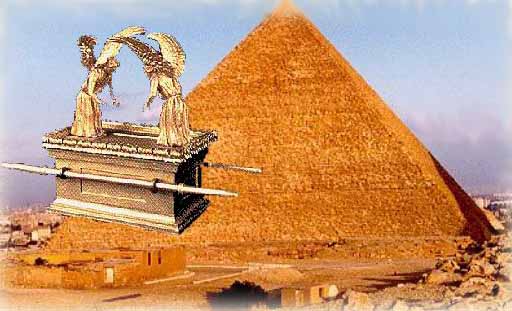
The word Ark comes from the Hebrew word 'Aron', which means a chest or box. Its dimensions are described by the bible as 2.5 cubits by 1.5 cubits by 1.5 cubits (62.5 inches by 37.5 inches by 37.5 inches). Curiously, this is the exact volume of the stone chest or porphyry coffer in the King's Chamber in the Great Pyramid in Egypt. This coffer was the only object within the King's Chamber, as the Ark was the single sacred object within the Holy of Holies, in the Temple. Also the laver, or basin, that the priests used to wash their feet had the identical cubit dimensions.
The cubit dimensions of the inner chamber of the Temple, the Holy of Holies, are precisely identical in size to the King's Chamber in the Pyramid and the same volume as the molten sea of water on the Temple Mount as prepared by King Solomon. Since the Pyramid was built and sealed long before the days of Moses, when he built the Ark and the Holy of Holies, and had remained sealed for over twenty-five centuries until the ninth century after Christ, there is no natural explanation for the phenomenon of both structures having identical volume measurements.
The pyramid itself possessed its own force centers: the heart of the King's Chamber, its most vital and sacred points, where divine energy was concentrated and especially powerful. And other chambers not yet discovered. The candidate undergoing initiation was placed in the great granite sarcophagus in the King's Chamber at the August moment of the initiation rites (Note: the purpose of Initiation is to bestow upon the disciple certain molecular changes in the body to handle higher energy) because the sarcophagus was in direct alignment with the down pouring ray of cosmic light through the Ark in the Third Eye capstone. The voltage of such a fiery light ray could only be endured by one in whom the physical, emotional and spiritual forces were completely aligned and purified.
The candidate with an unbalanced polarity ran the risk of injury to the physical organism, or even death, because of the accelerated frequencies of manna-loa pouring through the capstone.
When the massive structure was first constructed, the final portion to be levitated into place was the gleaming gold and crystal capstone containing the original Ark of the Covenant, allegedly brought from Atlantis. This Ark and capstone graced the very summit of Knut. Once this floating capstone was so placed, the Great Ones created several lesser Arks.
The voltage of a second Ark was integrated into the structure of the open granite sarcophagus in the King's Chamber. Since granite is saturated with minute crystals, it was not difficult to charge the initiatory coffer with incredible cosmic force. Hence the uninitiated unprotected sons of Earth were not permitted to touch the Ark because of its radiating voltage, placed there by generated cosmic rays. The priests who had charge of it, called the Arkites, wore protective garments. But they were themselves charged with cosmic power.
Such human Arks allegedly were somewhat immune from the rays of the crystal because each radiated frequencies harmonious with the crystal. Since the Ark radiated an energy destructive to all inharmonious with it, a gold sheath was constructed to insulate it, to partially shield the people from the powerful emanations.
To maintain its potency, each Ark had to be constantly recharged with a creative energy of tremendous voltage. The principal source of that energy was man himself, and only the highest initiates were capable of radiating the particular force required to keep the Ark active.
Much of this responsibility fell upon the high priests, the Arkites or Ptahs of the temple, who, if they so willed it, could raise the frequency of their forms to radiate so powerful a force that an initiate touching their bodies could be struck down, just as if he had touched the Ark itself. Rarely was such voltage require of them, except to recharge the Arks.
The crystals and compounds of which the Ark were allegedly constructed - the silver, brass-like substance, and pure living gold - were charged with seven octaves of energy, from the materialistic charges of electric voltage up to the highest spiritualized forces of celestial planes - pranic forces far beyond the voltage of Earth's electricity.
Ellie and the Ark The Ark is a metaphor for a container, box, or vessel which holds a source of creational light [soul]. We are as soul sparks of light consicousness, experiencing 'inside the box' - a virtual reality grid program. Sacred Geometry. To quest for the Ark is to quest for the nature of reality, creation, and where it is all quickly evolving in the alchemy of time.